Your agent reads the rule
when the task needs it
One canonical set of engineering practices, written once, loaded on demand by Claude Code, Codex, Copilot, Cursor and Antigravity. Your instruction file stops being re-read in full on every request.
Claude Code, from anywhere
/plugin marketplace add huseyn0w/agentic-development-kit
No clone, no per-project setup. Every other tool installs from a checkout.
ONE CANON, FIVE CODING TOOLS
17
SKILLS IN THE CANON
~1,600
TOKENS ALWAYS-ON, ALL 17
~53,000
TOKENS PAID ONLY ON TRIGGER
1
TEST GATE, EVERY TOOL
01 The problem
Instruction files only grow
Every project starts with a short CLAUDE.md. Then a convention is added, then a gotcha, then the thing that broke last month. Nothing is ever removed, and the whole file is read on every single request.
Paid in full, every time
A 434-line instruction file costs the same on “fix this typo” as it does on a database migration. There is no partial read.
Copied across repositories
The same rules about repositories, validation and tests live in five projects and drift apart in all five.
Rewritten per tool
CLAUDE.md, AGENTS.md, .cursorrules, copilot-instructions.md. Four files, one set of practices, four chances to disagree.
02 How it works
Write once, load on trigger
Skills invert the cost. A tool sees only each skill's name and one-line description until a task actually calls for one, then it reads the body.
STEP 01
Author in skills/
One directory is the canon. Front matter is validated on every build: the name must match the directory, the description is capped at 400 characters because it is loaded in every session, and a Non-negotiables section is mandatory.
STEP 02
scripts/sync.sh generates the rest
Adapters per tool, the installable plugin bundle and the marketplace entry are all generated. Editing them is pointless - the next sync overwrites the change. Changing skill content without a version bump is refused outright.
STEP 03
The agent reads what it needs
A Django question loads elman-django. A migration question loads elman-sql-db beside it. The other fifteen bodies cost nothing that request.
03 Token economy
The measurements, including the ones that look bad
Seventeen descriptions cost about 1,600 tokens per session, always. Where the instruction file was bloated, the kit pays for itself several times over. Where it was already small, the kit costs more. Both are below.
| Project | CLAUDE.md before | after | per request now | net |
|---|---|---|---|---|
| agentic-cms-django | 8,575 | 1,008 | 2,606 | −5,969 |
| agentic-cms-ts | 9,062 | 3,202 | 4,800 | −4,262 |
| agentic-cms-laravel | 3,990 | 3,328 | 4,926 | +936 |
| wordmcpress | 1,647 | 1,697 | 3,295 | +1,648 |
| standout-cv | 916 | 966 | 2,564 | +1,648 |
| smarthiring.tech | 142 | 192 | 1,790 | +1,648 |
| across the six | 24,332 | — | 19,981 | −4,351 |
Measured 2026-07-27 at roughly four characters per token. Django and TypeScript carry the whole win; the other four are net negative on tokens alone. If a small project does not want the trade, disable the plugin there - it is a per-scope setting.
Three tiers, very different prices
The build caps descriptions at 400 characters where the Agent Skills specification allows 1,024. At 1,024 the permanent cost would be roughly 2.5 times higher, for content nobody asked for.
04 The canon
Seventeen skills
Five tied to a stack, twelve that apply whatever you are writing. Every claim inside them is grounded in a primary source and cited inline, with the URL checked rather than recalled.
Stacks
5 skillselman-laravel-inertia
Laravel 12 and Inertia 2 on PHP 8.3. Repositories, models in app/Http/Models, observer registration, Pest, Pint and Larastan.
elman-django
Django 5.2 LTS on Python 3.12. App layout, migrations, select_related and prefetch_related, django-parler, pytest-django.
elman-react-next-ts
Next.js 15 App Router, React 19, NestJS 10 and Prisma. Strict TypeScript, server and client boundaries, Vitest and Playwright.
elman-kotlin-spring
Kotlin with Spring Boot on Gradle. Null safety, thin controller-service-repository layering, transactions, the JPA N+1 trap.
elman-golang
Idiomatic Go. Package layout, error wrapping, context propagation, errgroup, table-driven tests and the race detector.
Cross-cutting
12 skillselman-security
Injection, XSS, CSRF, SSRF, authorization checks, secrets, uploads and security headers, across all five languages.
elman-auth-practices
Password storage, session and cookie lifecycle, JWT pitfalls, refresh rotation, OAuth and OIDC, MFA, lockout, reset.
elman-testing-tdd
The test pyramid, unit against integration against e2e, doubles, flaky tests, and coverage read as a signal rather than a target.
elman-clean-code
Naming, function size, argument count, control-flow depth, early returns, and duplication against premature abstraction.
elman-code-review
Both sides of the review: what should block a pull request, and how to structure a change so it can be reviewed at all.
elman-arch-conventions
Thin entry points, logic in services or model methods, database access through repositories, and where each stack differs on purpose.
elman-design-patterns
Which pattern to reach for, what it costs, and the signal that justifies it. Organised by problem rather than by GoF category.
elman-ddd
Ubiquitous language, bounded contexts, aggregates and domain events, each priced by its cost. Including when a CRUD app needs none of it.
elman-sql-db
MySQL 8.4 and PostgreSQL 16. Index selection, EXPLAIN ANALYZE, N+1 across four ORMs, keyset pagination, live-table migrations.
elman-ci-cd
GitHub Actions job structure, caching, matrix builds, required checks, pull_request_target risks and third-party action pinning.
elman-docker-k8s
Dockerfile layer ordering, multi-stage builds, non-root users, healthchecks and Compose. Kubernetes only past a single VPS.
elman-design
The monochrome design language: palette, Geist type scale, spacing tokens, mandatory focus rings, motion and the accessibility floor.
05 Coverage
Two delivery paths, stated plainly
Four tools read .agents/skills/ natively, so one copied directory serves all of them. Claude Code does not, and is served by a plugin instead - which is better anyway, because it then works in every project without copying anything into any of them.
| Tool | Route | What it reads |
|---|---|---|
| Claude Code | Plugin | Skills, hooks, the /token-check command and the context status line, installed once at user scope. |
| OpenAI Codex | Native | .agents/skills/ - names and descriptions only until a task triggers a body. |
| GitHub Copilot | Native | .agents/skills/ in VS Code and the CLI. |
| Cursor | Native | .agents/skills/ |
| Google Antigravity | Native | .agents/skills/ |
| Copilot in JetBrains, Xcode, Eclipse | Fallback | .github/copilot-instructions.md - an index plus each skill's Non-negotiables, never the full text. |
The static fallback exists because Copilot inside JetBrains, Xcode and Eclipse cannot load skills at all. It carries an index and each skill's Non-negotiables section, which is why that section is mandatory in the front matter contract. If every tool you use supports skills, skip it.
06 Test gate
One gate, whoever runs the push
A single pre-push hook instead of five per-tool variants. It fires the same way for you, for Claude Code, for Codex, Copilot, Cursor and Antigravity.
-
No
.claude/test-gate.shin the repository and the push proceeds untouched. Installing the hook cannot break a project that has not opted in. - A gate that fails aborts the entire push. Nothing is sent, because git is all-or-nothing here rather than per-ref.
-
An agent reaching for
git push --no-verifyskips the git hook entirely, so a second guard blocks that tool call outright. - A broken symlink where the gate should be is treated as a misconfiguration, not as an absence. It refuses rather than guessing.
Context tooling, beside the canon
Handoff across compact and clear
Branch, uncommitted work and diff stat are recorded before a compaction or a clear, and injected back on the next session start. The transcript format is never parsed - it is internal and documented as changing between releases.
Context status line
The status line is the only surface that receives live context usage; no hook event carries a token count. It renders and colours the threshold. Clearing stays a human decision.
/token-check
One recommendation - clear, compact or continue - with reasoning that names what is still load-bearing. It also flags large tool output that should have gone to a subagent.
07 Quality panel
How many edits did it test?
The kit records what your agent actually did and reports it two ways. The number worth watching is verified edits: “23 edits, 0 verified” says Claude changed 23 things and never checked one of them.
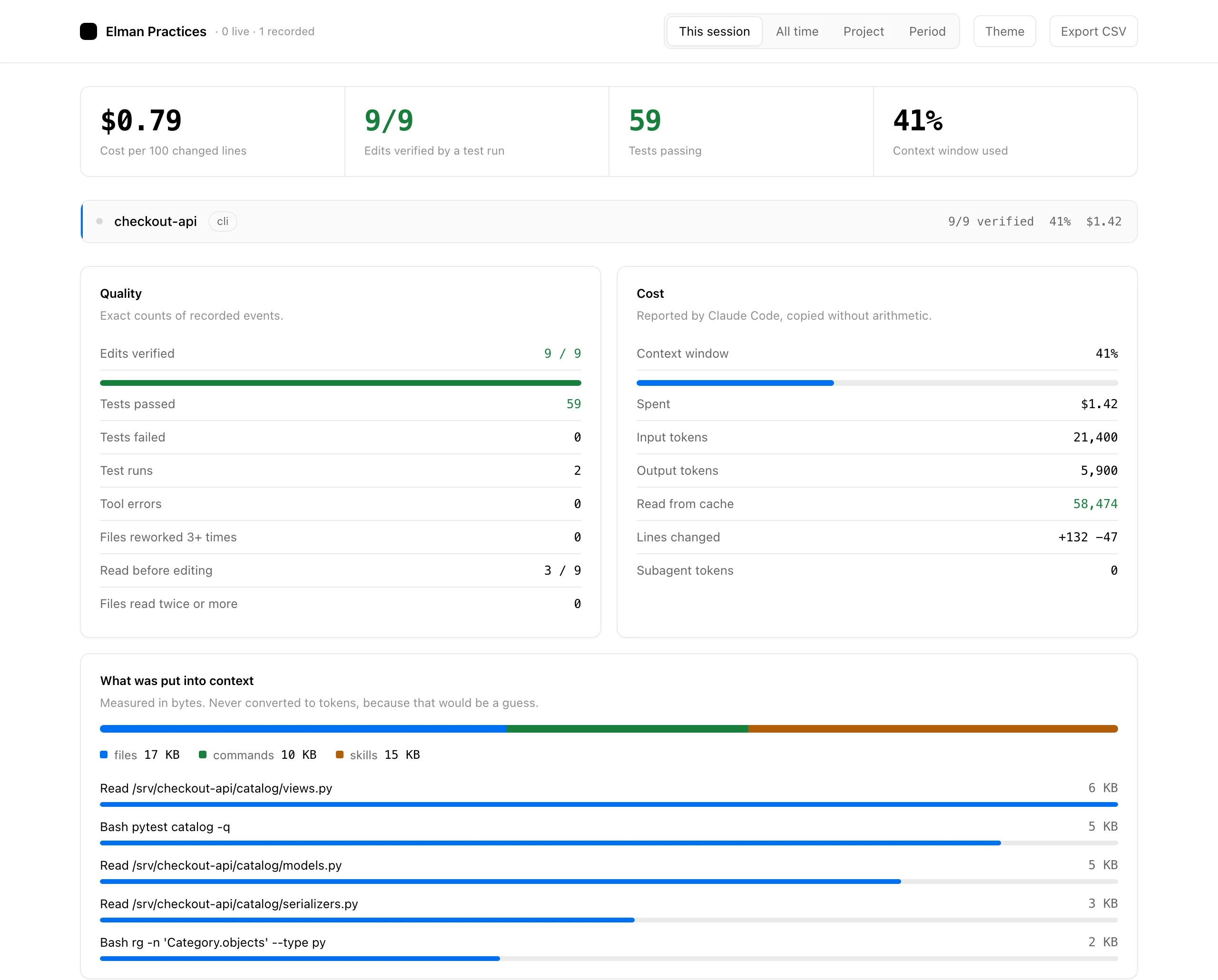
The rule every number obeys
Nothing on the panel is estimated, and that is enforced rather than intended: the test suite asserts that no counter converts bytes into tokens, and that costs stay absent instead of showing zero before they are known.
- A read of 180 KB is shown as 180 KB. “That read cost 45k tokens” would be a guess, so it is never displayed.
-
A failed run is not a failed test. A
pytestcall with the wrong path exits non-zero without a single test failing, and is counted separately. -
The
why:line joins a skill call to the prompt that caused it onprompt_id. It is a join, not a guess. - Measured overhead: 43 ms per hook invocation, run asynchronously so nothing waits on it, and zero context - none of it is shown to the model.
/skill-monitor — the same data, in the terminal
Which skills earn their place
Four charts over every session you have run: cost per 100 lines by week, verified edits by week, skills by times loaded, and cost by project. The footer names every skill that has never loaded, and each of those still costs its description in every session. That is a direct list of what to cut.
Local, and quiet about it
Everything stays on the machine. The panel binds to 127.0.0.1 on a port the OS picks, and has no authentication, so it must not be exposed. Test output is parsed at record time and discarded - only the counts are kept. ELMAN_SKILL_LOG=off records nothing at all.
What it will not claim
Not whether an answer was good - there is no ground truth, so no such number exists. Not why the model picked a skill; no hook carries it. Not a comparison against working without the kit, which needs an experiment rather than a counter. Measured limitation: the VS Code extension does not invoke a command status line, so those sessions show quality but say so in place of cost.
08 Install
Dry run by default
Every script shows exactly what it would write and touches nothing until you pass --apply. That is how you check the kit before trusting it with a live repository.
Claude Code
Two lines in any session, no clone. The plugin carries the skills, the hooks, the command and the status line, at user scope - so every project has it.
/plugin marketplace add huseyn0w/agentic-development-kit
/plugin install elman-practices@elman-marketplace
GitHub Copilot CLI
The same plugin bundle, installed straight from the repository.
$ copilot plugin install huseyn0w/agentic-development-kit:plugins/elman-practices
Into a project: Codex, Cursor, Antigravity
Skills for every tool that reads files from the repository, the static fallback for editors that cannot load skills at all, and the push gate.
$ git clone https://github.com/huseyn0w/agentic-development-kit
$ agentic-development-kit/scripts/install.sh ./my-app --skills --static --hooks --apply
Shrink a project's CLAUDE.md
Removes what a skill now covers, shows a diff, keeps a .bak. This is the step that produced the numbers above.
$ scripts/claude-md-slim.sh ./my-app --apply
Read it before you trust it.
It is all on GitHub.
Seventeen skills, the generator, the push gate and the measurements that argue against it in places. MIT licensed.